Parakh drives educational reforms in Puducherry, focusing on board equivalence and competency-based assessments.
State Council of Educational Research and Training (SCERT)
Directorate of School Education, Government of Puducherry
Overview: Equivalence of Boards Framework
The Equivalence of Boards framework under SCERT, Union Territory of Puducherry, ensures a seamless, transparent, and fair academic migration path for students. In alignment with the National Education Policy (NEP 2020) and the national PARAKH guidelines, this platform establishes standardized benchmarks to evaluate and recognize secondary (Class 10) and senior secondary (Class 12) certifications from various school education boards across India.
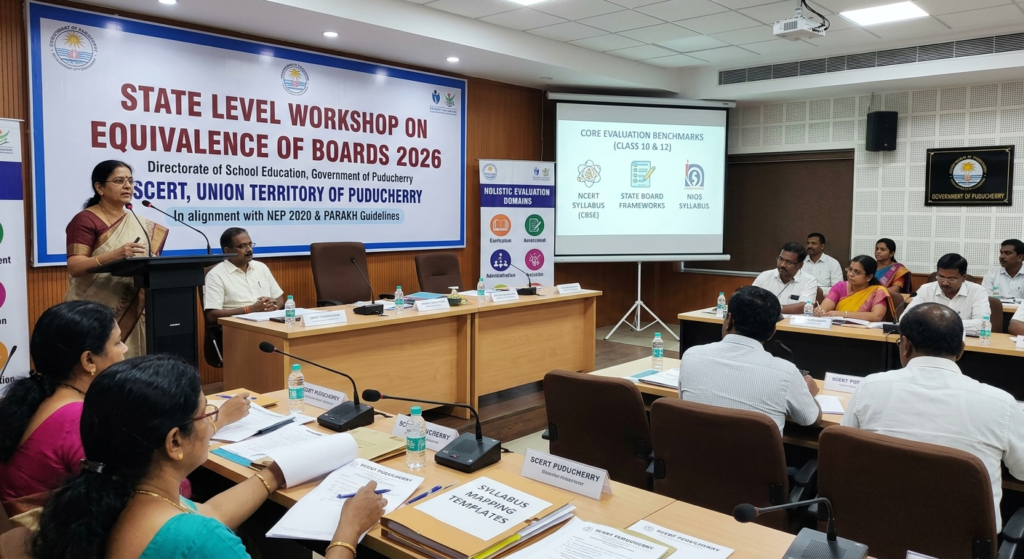
📢 Key Update (2026 Workshop Resolution): As finalized during the SCERT “State Level Workshop on Equivalence of Boards 2026”, structural and academic equivalence within the Union Territory is determined through rigorous syllabus mapping and strict adherence to standardized eligibility benchmarks.
1. Core Evaluation Benchmarks (Class 10 & 12)
To maintain high academic standards while ensuring student mobility across Puducherry’s unique regional layout, equivalence for any recognized national or state board is granted based on two fundamental pillars:
Syllabus Mapping: The core curriculum of the applicant board for Class 10 and Class 12 must map seamlessly to national frameworks.
Eligibility & Benchmark Standards: The curriculum and assessment patterns are strictly benchmarked against:
NCERT Syllabus (as followed by the Central Board of Secondary Education – CBSE).
State Board Frameworks (such as the Tamil Nadu State Board framework historically linked with the Puducherry/Karaikal regions, and corresponding state boards for Mahe and Yanam enclaves).
NIOS Syllabus (National Institute of Open Schooling) for open and distance learning pathways.
Boards meeting these syllabus-matching thresholds are granted mutual recognition, allowing students to transition into the UT’s educational ecosystem or seek government employment without administrative barriers.
2. Framework & Evaluation Domains
Equivalence is assessed holistically across five distinct structural parameters:
Domain
Assessment Focus
Curriculum Alignment
Core alignment percentages with NCERT/State Board learning outcomes.
Assessment Standards
Quality and cognitive demand of Class 10 & 12 question papers under PARAKH guidelines.
Administration
Legal status, validity, and regulatory integrity of the certifying board.
Inclusive Practices
Provision of accommodations for linguistic diversity (Tamil, Telugu, Malayalam, and French mediums).
Vocation & Credits
Integration of skill-based learning in line with the National Credit Framework (NCrF).
3. Approval and Registration of Private Boards
To expand quality educational choices while safeguarding student interests, the Directorate of School Education, Government of Puducherry, has empowered SCERT to evaluate private schooling boards.
Statutory Mandate
Operational Approval: SCERT, UT of Puducherry, reserves the authority to grant formal approval to private boards seeking to operate within the four geographical regions of the Union Territory (Puducherry, Karaikal, Mahe, and Yanam).
Quality Assurance Criteria
Approval is strictly merit-based and will only be granted if the private board satisfies comprehensive quality parameters, including:
Complete transparency in governance and examination evaluation.
Curriculum parity with the NCERT/CBSE/State Board pedagogical standards.
Robust digital infrastructure and verifiable student tracking mechanisms.
Fair assessment models that test competency rather than rote memorization.
⚠️ Regulatory Note: Private boards failing to maintain these high-quality benchmarks will face immediate non-recognition or de-affiliation within the UT of Puducherry.
Administration
State Council of Educational Research and Training,
Union Territory of Puducherry, Kurumbapet, Villianur, Puducherry – 605110 (INDIA)